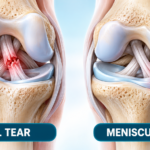

When patients hear the words Knee Replacement Surgery, many assume that an arthritic or painful knee will eventually have to be replaced.
I do not look at it that way.
My first question is always:
Can we still preserve the natural knee?
For me, knee replacement is not the starting point of treatment. It is an option that becomes relevant when pain, structural damage and loss of function have reached a stage where joint-preserving treatment is no longer giving the patient a meaningful quality of life.
The right time for surgery is therefore not decided by age alone, an X-ray alone or the availability of advanced technology.
It is decided by the patient, the condition of the joint and how much the knee problem is affecting everyday life.
Who Needs Knee Replacement Surgery?
The patients who may eventually need Knee Replacement Surgery usually have significant damage inside the knee combined with persistent symptoms.
The most common reason is advanced knee arthritis. Knee arthritis is also the leading reason people undergo knee replacement.
However, simply having arthritis does not automatically mean a patient needs surgery.
I look more closely at questions such as:
Is the pain affecting normal walking?
Is the patient struggling with stairs or standing for longer periods?
Is knee stiffness limiting movement?
Is pain disturbing sleep?
Has the patient stopped doing everyday activities because of the knee?
Most importantly, have appropriate non-surgical treatments already been tried?
If pain, stiffness and swelling remain severe despite other treatments, then When Is Knee Replacement Necessary becomes a serious and reasonable discussion. Cleveland Clinic identifies persistent pain, stiffness and swelling that do not improve after other treatment as important signs that replacement may be appropriate.
An X-Ray Alone Should Not Decide Surgery
One of the most important things I tell my patients is that we do not operate on an X-ray.
We treat the person.
Two people can have very similar arthritis on imaging and experience completely different levels of pain and disability.
One may still walk independently and perform routine activities comfortably.
Another may have severe pain while getting out of a chair, climbing stairs or even resting at night.
So when I assess Signs You Need Knee Replacement, I combine imaging findings with symptoms, movement, stability, alignment, activity level and the patient’s expectations.
The decision should never be based on one factor alone.
What Should Be Tried Before Knee Replacement?
Before recommending Knee Joint Replacement, I want to know whether we still have reasonable ways to protect and support the natural knee.
Depending on the individual patient, Alternatives to Knee Replacement Surgery may include physiotherapy, muscle strengthening, appropriate exercise, activity modification, weight management, pain-relieving medication and selected injection treatments.
Some patients may also be suitable for procedures that preserve more of their natural joint.
The aim is not to postpone surgery endlessly.
The aim is to avoid doing it earlier than necessary.
This distinction is important.
Joint preservation means giving the natural knee a fair opportunity to continue functioning when that is medically sensible.
When Is the Right Time for Knee Replacement?
There is no universal age or exact date that defines the Best Time for Knee Replacement.
For me, timing becomes appropriate when three things begin to come together:
The joint damage is significant.
The symptoms are persistent and affecting normal life.
And appropriate non-surgical treatment is no longer providing adequate relief.
At that stage, asking Should I Get Knee Replacement becomes less about whether surgery exists and more about whether continuing to live with the damaged joint is limiting the patient more than the operation and recovery would.
This is a highly individual decision.
A patient who cannot sleep, walk comfortably or maintain independence may need a different treatment approach from someone whose symptoms are still manageable despite similar imaging findings.
Total Knee Replacement or Partial Knee Replacement?
Not every patient requires a Total Knee Replacement.
A total replacement generally addresses all major compartments of the knee joint, while a Partial Knee Replacement replaces only the affected portion when the disease is sufficiently localised. Cleveland Clinic describes total and partial replacement as the two main categories of knee arthroplasty.
This is another area where my joint-preservation philosophy matters.
If only one part of the knee is severely damaged and the remaining structures are healthy and stable, I consider whether preserving more of the natural knee is possible.
Partial replacement is not suitable for everyone, but the principle remains important:
Why replace healthy structures if they can safely be preserved?
On the other hand, when arthritis is advanced across multiple areas of the joint, Total Knee Arthroplasty may be the more appropriate option.
Knee Replacement for Osteoarthritis
Knee Replacement for Osteoarthritis is generally considered when arthritis has progressed enough to create persistent pain and significant functional limitation.
But arthritis develops gradually, and there is often a long period during which joint-preserving treatment remains possible.
That is why I encourage patients to seek assessment before they reach the point where they can barely walk.
Early evaluation gives us more options.
It allows us to work on muscle strength, joint loading, movement patterns and lifestyle factors while useful joint function still remains.
By the time Knee Arthritis Surgery becomes necessary, the decision should ideally be based on a clear history of symptoms and treatment—not simply on one bad day of pain.
What Happens During Knee Replacement Surgery?
During Knee Replacement Surgery, the damaged cartilage and a small amount of underlying bone are removed or resurfaced, and prosthetic components are placed to recreate the joint surfaces.
The entire leg is not replaced, and the whole knee is not simply “removed.”
This is something patients often misunderstand.
The purpose of the operation is to replace the damaged joint surfaces so that pain can be reduced and movement can improve.
Cleveland Clinic describes knee arthroplasty as replacement of some or all damaged parts of the knee with prosthetic components.
What About Knee Replacement Risks?
Like every major operation, Knee Replacement Surgery has potential risks.
These can include infection, blood clots, stiffness, nerve or blood-vessel problems and complications involving the implant. Such complications are uncommon but should still be discussed before surgery.
I believe patients should understand both the potential benefits and the limitations of surgery before making the decision.
The goal is not simply to replace an X-ray.
The goal is to improve pain, movement and quality of life when other reasonable options are no longer sufficient.
Knee Replacement Recovery: What Should Patients Expect?
Knee Replacement Recovery is a process, not an overnight event.
Walking and basic daily activities usually return progressively as rehabilitation continues.
Physiotherapy is an important part of restoring movement, strength and confidence in the new joint.
Cleveland Clinic notes that many patients can gradually resume usual activities within several weeks, although complete recovery can take much longer and varies according to age, activity level and overall health.
I prefer patients to think of recovery in stages rather than focusing on one fixed deadline.
Where Does Robotics Fit Into My Approach?
Robotic-assisted surgery, navigation, advanced imaging and modern surgical planning can be useful tools.
But they remain tools.
They do not decide Who Needs Knee Replacement Surgery.
That decision still depends on clinical examination, symptoms, imaging, function and medical judgment.
My training at AIIMS, followed by exposure to sports medicine and joint-preserving techniques in South Korea and further experience at Rush University in the USA, strengthened my belief that technology should support the treatment philosophy—not become the philosophy itself.
If the natural joint can still be preserved effectively, the availability of robotic technology does not create a reason to operate.
If Knee Replacement Surgery genuinely becomes necessary, then appropriate technology can help us plan and perform that procedure more precisely.
My Approach: Preserve First, Replace When Necessary
I do not believe the goal of modern orthopaedics should be to perform replacement surgery earlier simply because we are capable of doing it more precisely.
The goal should be to make the right decision at the right stage.
Sometimes that means physiotherapy and strengthening.
Sometimes it means medication or injections.
Sometimes it means a joint-preserving procedure.
And sometimes, when arthritis is advanced and quality of life has genuinely deteriorated, it means knee replacement.
The treatment may change.
The philosophy does not.
Final Thoughts
Knee Replacement Surgery can be an effective treatment for patients with advanced knee damage and persistent pain, but it should not be considered automatically because arthritis appears on an X-ray.
The right time is when symptoms, structural damage and loss of function together show that conservative or joint-preserving options are no longer achieving enough.
My approach remains simple:
Preserve the natural knee when we reasonably can. Replace it when we genuinely need to. And use technology to support that decision—not to make it for us.