
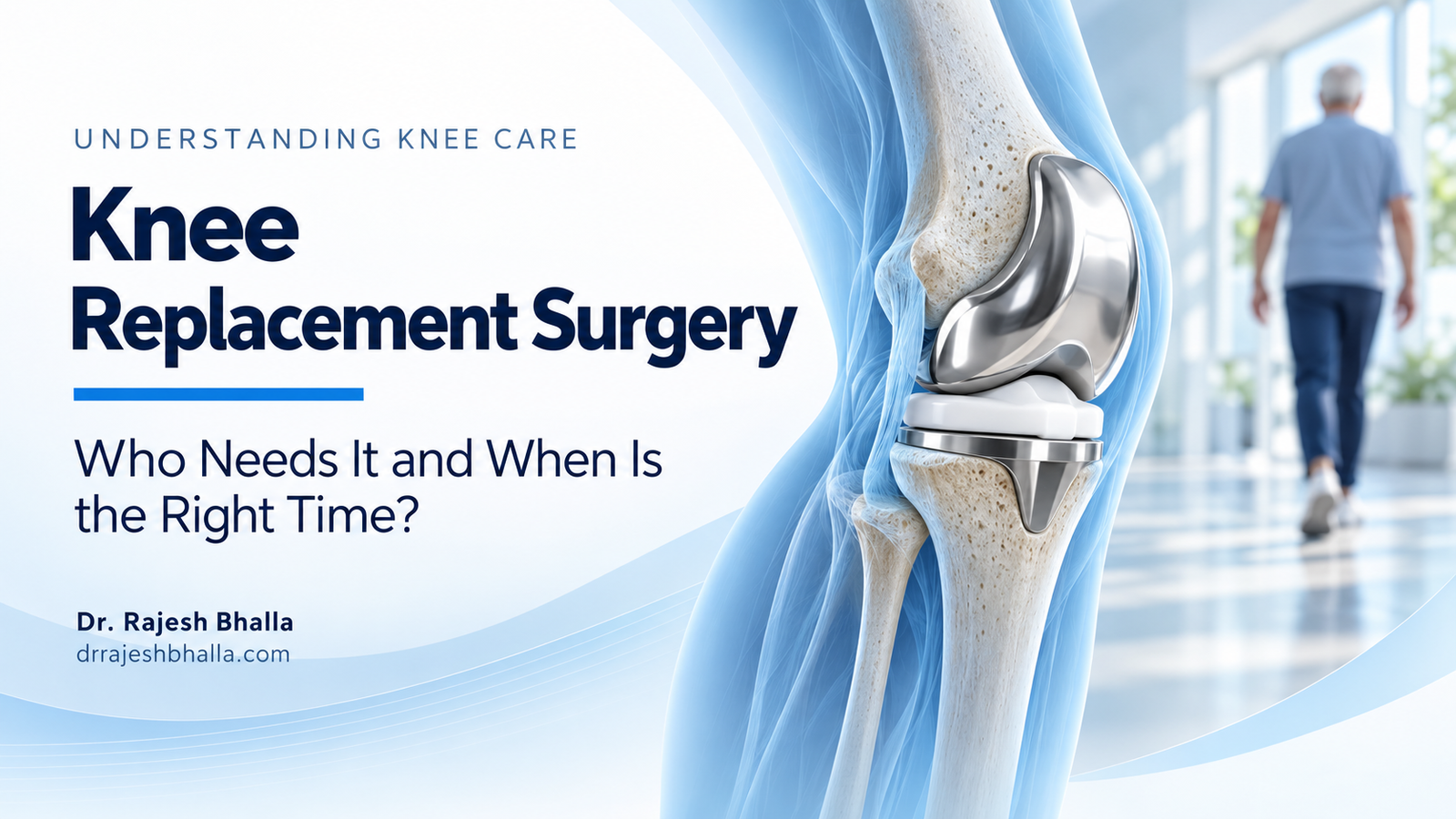
Knee Replacement Surgery: Who Needs It and When Is the Right Time?
When patients hear “knee replacement surgery,” they often assume that severe knee pain or arthritis automatically means the knee must be replaced. That is not always the case.
My first question is usually: Can we still preserve the natural knee?
Knee replacement is generally considered when knee damage has become advanced, pain is persistent, daily activities are significantly affected, and appropriate non-surgical treatments are no longer providing enough relief. At Prof. Dr. Bhalla’s practice, treatment is planned according to the patient’s symptoms, joint condition, lifestyle and individual needs.
Who May Need Knee Replacement Surgery?
The most common reason for knee replacement surgery is advanced osteoarthritis. However, having arthritis on an X-ray does not automatically mean you need surgery.
I look at how the condition is affecting your everyday life.
You may need to discuss knee replacement if you have:
- Persistent or severe knee pain
- Difficulty walking or climbing stairs
- Increasing knee stiffness
- Pain that affects sleep
- Difficulty standing for longer periods
- Significant loss of mobility
- Knee deformity or advanced joint damage
- Little or no improvement with appropriate non-surgical treatment
The decision should be based on the complete clinical picture rather than an X-ray alone.
When Is the Right Time for Knee Replacement?
There is no single age at which everyone should undergo knee replacement surgery.
The right time is usually when joint damage, persistent symptoms and reduced quality of life come together, particularly when medicines, physiotherapy, exercise, weight management, activity modification or selected injections are no longer providing sufficient relief.
My approach is not to perform replacement surgery simply because arthritis is visible. If the natural knee can still be treated effectively, joint-preserving options should be considered first.
What Should Be Tried Before Knee Replacement?
Depending on the condition, treatment may include:
- Physiotherapy and muscle strengthening
- Appropriate exercise
- Weight management
- Activity modification
- Pain-relieving medication
- Selected knee injections
- Joint-preservation procedures in suitable patients
The purpose is not to delay surgery indefinitely. The aim is to avoid replacing the knee earlier than medically necessary.
Total or Partial Knee Replacement?
Not every patient requires a total knee replacement.
If arthritis is mainly limited to one compartment of the knee and the remaining structures are suitable, partial knee replacement may be considered. This procedure replaces only the damaged portion while preserving suitable healthy structures.
When arthritis has affected multiple areas of the knee extensively, total knee replacement may be more appropriate. The choice depends on joint damage, alignment, ligament stability, symptoms and the patient’s overall condition.
What Happens During Knee Replacement Surgery?
During knee replacement, damaged joint surfaces are removed or resurfaced and replaced with prosthetic components. The purpose is to reduce pain and improve the function and movement of the knee.
Modern surgical planning and precision-based techniques can support accurate implant positioning, but technology should support clinical decision-making rather than replace it.
What Is Knee Replacement Recovery Like?
Knee replacement recovery is a gradual process. Rehabilitation focuses on restoring knee movement, improving muscle strength, walking ability and confidence in using the new joint.
Physiotherapy and regular follow-up are important parts of recovery. The exact recovery period varies depending on the patient’s age, health, activity level and the type of surgery performed.
My Approach to Knee Replacement
I believe the goal should not simply be to replace a damaged knee. The goal is to improve pain, restore function and maintain the best possible quality of life while preserving the natural knee whenever it is reasonably possible.
If the knee has reached a stage where pain and functional limitations are significantly affecting your life despite appropriate treatment, knee replacement surgery may become a reasonable option.
If you are experiencing persistent knee pain, stiffness or difficulty walking, an evaluation by an experienced knee replacement doctor in Delhi can help determine whether you need surgery or whether another treatment option may still be appropriate.
Prof. Dr. Rajesh Bhalla
Orthopaedic & Knee Specialist
Individual treatment should always be decided after a proper clinical evaluation.