A sudden twist while playing football, an awkward landing during badminton, or a quick change in direction can leave you with a painful, swollen knee. You might hear a popping sound, feel instability, or find it difficult to walk comfortably.
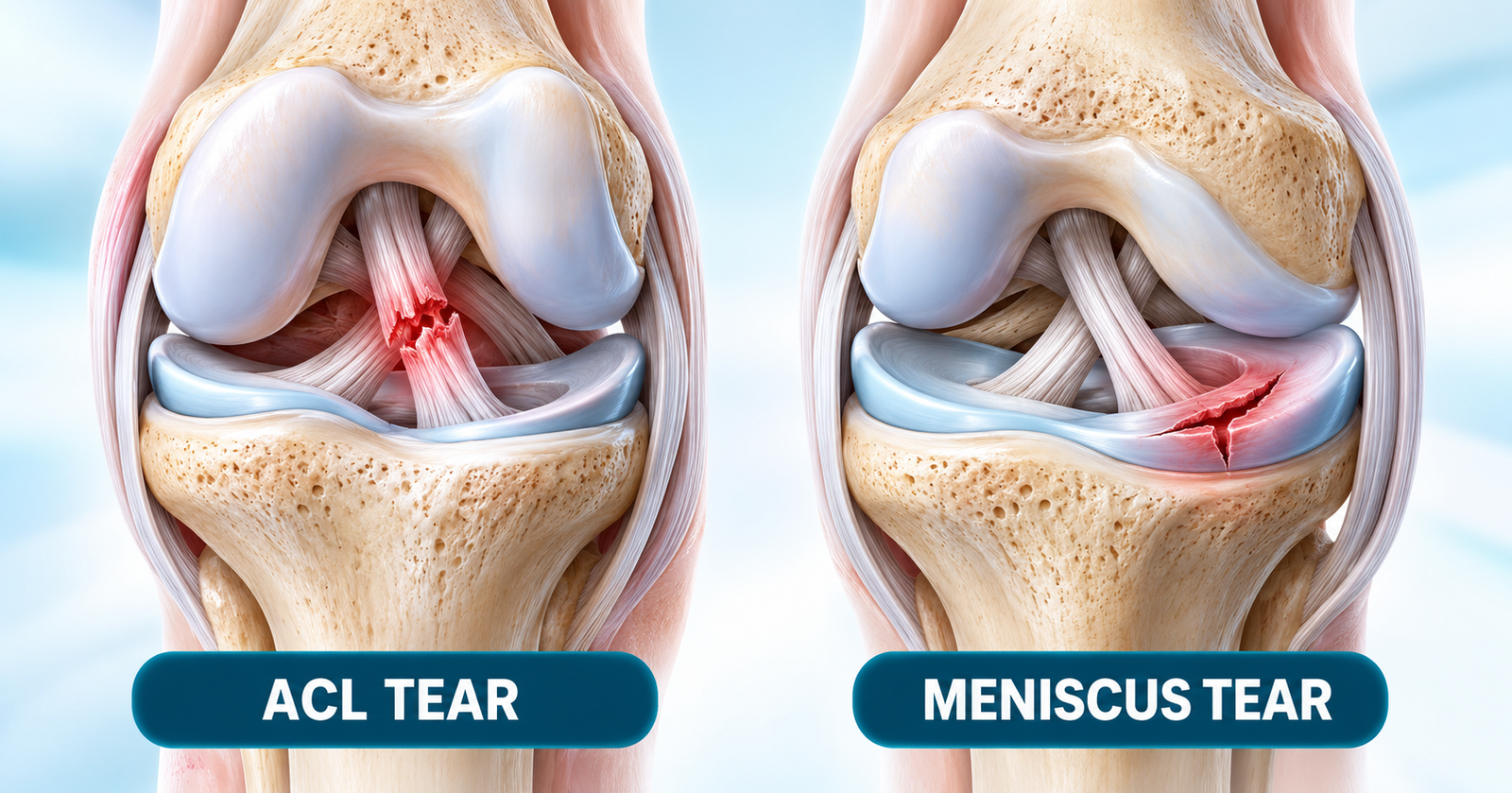
Two common injuries associated with these situations are an anterior cruciate ligament (ACL) tear and a meniscus tear.
Although both affect the knee joint and may occur during similar activities, they involve different structures and often require different treatment approaches.
Understanding meniscus tear vs ACL injury can help patients recognise common knee injury symptoms and explore appropriate treatment options. The key differences between a meniscus tear vs ACL injury involve the affected structures, knee stability, symptoms, and recovery process.
For professional orthopedic consultation, patients can visit the website of Dr. Rajesh Bhalla.
What Is the Difference Between a Meniscus Tear and an ACL Injury?
An ACL injury involves damage to a ligament that helps stabilise the knee, particularly during twisting and sudden changes in direction. A meniscus tear affects one of the cartilage structures that cushion and distribute weight across the joint. ACL injuries often cause instability, while meniscus tears may cause joint-line pain, catching, or locking. However, symptoms overlap, and a clinical examination is needed for an accurate diagnosis.
Both injuries can occur together, especially during twisting sports injuries.
Understanding the Knee Joint
The knee is formed by the thighbone (femur), shinbone (tibia), and kneecap (patella). Ligaments, cartilage, tendons, and muscles work together to provide stability and allow movement.
Two important structures are the ACL and the meniscus.
What Is the ACL?
The anterior cruciate ligament is located inside the knee. It connects the femur to the tibia and helps control forward movement and rotation of the shinbone.
ACL injuries commonly occur during sudden stops, pivoting movements, changes in direction, or awkward landings.
A torn ACL may affect knee stability, particularly during activities that involve turning or jumping.
What Is the Meniscus?
Each knee contains two menisci: the medial meniscus on the inner side and the lateral meniscus on the outer side.
These crescent-shaped fibrocartilage structures help distribute forces across the knee joint and contribute to joint stability.
Meniscus tears may develop during sports injuries, sudden twisting movements, or age-related changes in cartilage tissue.
Meniscus Tear vs ACL Injury: 7 Key Differences
Although both injuries can cause knee pain and swelling, they affect different structures and may require different treatment approaches. The following comparison highlights seven important differences between a meniscus tear vs ACL injury, including symptoms, knee stability, diagnosis, treatment, and recovery.
| Feature | ACL Injury | Meniscus Tear |
|---|---|---|
| 1. Injured structure | Anterior cruciate ligament | Medial or lateral meniscus |
| 2. Main function affected | Joint stability and rotational control | Load distribution and cushioning |
| 3. Common mechanism | Sudden pivot, landing or change in direction | Twisting while weight-bearing or degeneration |
| 4. Typical symptoms | Instability, swelling, pain and sometimes a pop | Joint-line pain, swelling, catching or locking |
| 5. Swelling pattern | Often develops rapidly after an acute major tear | May develop more gradually, although it varies |
| 6. Diagnosis | Clinical stability tests and MRI when indicated | Joint-line examination, meniscal tests and MRI when indicated |
| 7. Treatment | Rehabilitation, with reconstruction in selected cases | Rehabilitation, meniscus repair or other procedures when appropriate |
These differences provide general guidance, not a method of self-diagnosis. Both injuries may produce similar symptoms, and some patients have damage to both structures.
1. How Do ACL Injury Symptoms Differ from Meniscus Tear Symptoms?
The symptoms can overlap, but certain patterns may help doctors identify which structures could be injured.
Common ACL Tear Symptoms
An ACL tear may cause:
- A popping sensation at the time of injury
- Rapid swelling after significant injury
- Pain during weight-bearing
- A feeling that the knee may give way
- Reduced confidence when changing direction
- Difficulty returning to sports
Some patients can walk after an ACL tear. Being able to walk does not rule out a significant ligament injury.
Common Meniscus Tear Symptoms
A meniscus tear may cause:
- Pain along the inner or outer knee joint line
- Swelling or stiffness
- Discomfort while squatting or twisting
- Catching or clicking during movement
- Difficulty fully straightening the knee
- Occasionally, true mechanical locking
Not every clicking knee has a meniscus tear. Clicking can occur without significant structural damage.
Can Symptoms Confirm the Diagnosis?
No. Symptoms alone cannot reliably distinguish an ACL tear from a meniscus tear.
An orthopedic examination evaluates joint stability, tenderness, swelling, and range of movement. Imaging may be recommended when the findings suggest an internal knee injury.
2. What Causes ACL Tears and Meniscus Injuries?
Both injuries are commonly associated with sports, but they can also occur during everyday activities.
ACL Injury Causes
ACL injuries frequently involve movements such as:
- Sudden changes in direction
- Pivoting while the foot remains planted
- Landing awkwardly after a jump
- Abrupt deceleration
- Direct collision or trauma
Football, basketball, badminton, and other activities involving cutting or twisting movements can place stress on the ACL.
Meniscus Tear Causes
Meniscus tears may occur due to:
- Twisting while bearing weight
- Deep knee bending under load
- Sports-related pivoting
- Falls or traumatic injuries
- Degenerative changes with ageing
In older adults, some meniscus tears develop without a major sporting accident.
This distinction is important because a degenerative meniscus tear may require a different management approach from an acute traumatic injury.
3. Which Is More Serious: An ACL Tear or a Meniscus Tear?
There is no universal answer.
The seriousness of either injury depends on the extent of damage, knee stability, associated injuries, symptoms, and the patient’s activity requirements.
A complete ACL tear may significantly affect athletes who participate in pivoting sports. Persistent instability can also expose other knee structures to additional injury.
A meniscus tear may cause relatively mild symptoms in one patient but significant locking or restricted movement in another.
Some displaced meniscus tears require timely assessment because they interfere with normal knee movement.
Rather than comparing injuries by name alone, the priority should be understanding the actual damage and its effect on joint function.
4. Can an ACL Tear and Meniscus Tear Happen Together?
Yes. An ACL tear and meniscus tear can occur during the same knee injury.
A twisting movement that damages the ACL may also injure one or both menisci.
For example, an individual playing football may suddenly pivot while the foot remains planted. The force passing through the knee can affect more than one structure.
Combined injuries can complicate treatment decisions because the doctor must consider both stability and cartilage preservation.
The American Academy of Orthopaedic Surgeons recognises that ACL injuries frequently occur with other knee injuries, including meniscal damage.
A complete evaluation is therefore important when a major ACL injury is suspected.
5. How Are ACL and Meniscus Injuries Diagnosed?
Diagnosis begins with a detailed discussion of how the injury occurred.
An orthopedic specialist may ask whether the patient experienced a pop, how quickly swelling developed, whether the knee gives way, and whether catching or locking occurs.
Physical Examination
For a suspected ACL injury, the doctor may use the Lachman test or other ligament stability assessments.
For a possible meniscus tear, the examination may include joint-line tenderness assessment and tests such as McMurray or Thessaly.
No individual clinical test is perfectly accurate in every situation.
X-Ray
X-rays help identify fractures and certain associated bone abnormalities.
However, an X-ray does not directly show most ACL or meniscus tears.
MRI Scan
MRI can provide detailed images of the ACL, menisci, cartilage, and other internal knee structures.
It may help confirm a suspected injury, identify associated damage, and guide treatment planning.
An MRI is not automatically required for every episode of knee pain. The decision should follow clinical assessment.
6. Can ACL Tears and Meniscus Tears Heal Without Surgery?
Some patients with ACL injuries or meniscus tears can be treated without surgery, depending on the injury and their functional needs.
Treatment decisions depend on the type and severity of the injury, knee stability, activity level, and individual rehabilitation needs. While some patients benefit from physiotherapy and non-surgical care, others may require surgery.
Non-Surgical Treatment for ACL Injuries
Selected patients may benefit from:
- A structured physiotherapy programme
- Quadriceps and hamstring strengthening
- Balance and movement-control exercises
- Temporary activity modification
- Bracing when appropriate
- Gradual return to daily activities
Non-surgical management may be suitable for some patients whose knees remain functionally stable and whose activities do not involve high-demand pivoting.
However, persistent instability or associated injuries may change the treatment recommendation.
Non-Surgical Treatment for Meniscus Tears
Conservative management may include:
- Activity modification
- Physiotherapy
- Appropriate pain management
- Strengthening exercises
- Monitoring symptoms and function
Some meniscus tears may heal, particularly in areas with better blood supply. Others may remain structurally torn but become less symptomatic with rehabilitation.
Not every tear visible on MRI requires an operation.
When Might Surgery Be Considered?
Surgery may be recommended when symptoms, injury patterns, instability, or functional limitations make conservative treatment insufficient.
For ACL injuries, selected patients may benefit from reconstruction using a tendon graft.
For meniscus injuries, procedures may include arthroscopic repair or, when necessary, removal of only the damaged portion that cannot be preserved.
Modern meniscus treatment generally aims to preserve healthy meniscal tissue whenever feasible.
The choice of treatment should be individualised after discussing benefits, risks, and realistic recovery expectations.
7. How Long Does Recovery Take?
Recovery varies considerably according to the injury, treatment and rehabilitation progress.
ACL Injury Recovery
Some patients managed without surgery may require several months of rehabilitation to restore strength, movement and stability.
After ACL reconstruction, returning to high-demand pivoting sports often takes around 9–12 months or longer.
Readiness should be assessed through knee function, strength, movement quality and appropriate rehabilitation milestones, not simply the number of months since surgery.
Meniscus Tear Recovery
Some patients with minor or conservatively managed meniscus symptoms improve over weeks to months.
After surgical repair, rehabilitation may involve temporary movement or weight-bearing restrictions, and the return to demanding activity can take several months.
Recovery after a limited partial meniscectomy may be faster than after a meniscus repair, but the appropriate procedure depends on the tear and the long-term goal of protecting knee health.
A personalised rehabilitation plan is essential for either injury.
When Should You See an Orthopedic Doctor After a Knee Injury?
A medical assessment is recommended when knee symptoms persist, recur, or interfere with everyday activity.
Important warning signs include:
- Significant swelling after an injury
- Repeated knee instability
- Difficulty walking or bearing weight
- Persistent pain despite appropriate initial care
- A knee that becomes stuck or cannot straighten
- Restricted movement after a sports injury
Seek urgent medical evaluation for severe injury, obvious deformity, inability to bear weight, a cold or numb foot, or a hot swollen joint accompanied by fever.
Avoid forcing movement through a mechanically locked knee.
Early assessment can help identify significant damage and guide appropriate management.
Sports Injury Treatment in Delhi: Understanding Your Options
Sports-related knee injuries require careful evaluation because the visible symptoms do not always reveal the full extent of internal damage.
The aim of treatment is not simply to reduce pain temporarily. It is also to restore movement, strength, stability and confidence in everyday activity.
An orthopedic consultation may help determine:
- Whether the injury involves a ligament, meniscus, cartilage or another structure
- Whether X-rays or MRI are needed
- Whether rehabilitation is appropriate
- Whether surgical treatment should be considered
- When it may be safe to return to work, exercise or sports
For patients seeking specialist care in Delhi, choosing an appropriately qualified orthopedic doctor and following a structured rehabilitation plan are important steps.
Consult Prof. Dr. Rajesh Bhalla for Knee and Sports Injuries in Delhi
Knee pain after a sporting accident can be concerning, particularly when swelling, instability or restricted movement continues.
Prof. Dr. Rajesh Bhalla provides orthopedic consultation for knee conditions, ligament injuries and sports-related musculoskeletal problems in Delhi.
Patients can learn more about the available orthopedic services and discuss their symptoms during a consultation.
For related information, read:
- Ligament Injury: Types, Symptoms and Treatment Options
- Ligament Doctor in Delhi
- Best Orthopedic Doctor in Delhi
An appropriate treatment recommendation requires a clinical assessment and consideration of each patient’s individual condition.
Frequently Asked Questions About Meniscus Tear vs ACL Injury
1. How do I know if I tore my ACL or meniscus?
An ACL tear may cause instability and rapid swelling, while a meniscus tear may cause joint-line pain, catching or difficulty straightening the knee. However, these symptoms overlap. A physical examination, and sometimes MRI, is needed to distinguish the injuries.
2. Can you walk with an ACL tear?
Yes. Some people can walk after an ACL tear, particularly after the initial pain and swelling improve. However, the knee may remain unstable during turning or demanding activities. Walking ability does not confirm that the ACL is intact.
3. Can a meniscus tear heal naturally?
Some meniscus tears, particularly those involving areas with better blood supply, may heal. Others may not heal structurally but can become less painful with rehabilitation. Treatment depends on the tear’s location, pattern and symptoms.
4. Does every ACL tear need surgery?
No. Some patients can manage ACL injuries through rehabilitation and activity modification. Reconstruction may be considered when persistent instability, associated injuries or sporting requirements make it appropriate.
5. Can an MRI detect ACL and meniscus tears together?
Yes. MRI can help identify injuries affecting the ACL, menisci and other soft tissues. It is usually considered alongside the medical history and physical examination.
6. Which injury takes longer to recover from?
Recovery depends on injury severity and treatment. ACL reconstruction generally involves prolonged rehabilitation, while some meniscus injuries improve sooner. Meniscus repair can also require several months of recovery. Timelines vary by patient.
7. Is knee clicking always a sign of a meniscus tear?
No. Knee clicking can occur without a significant injury. However, painful clicking accompanied by swelling, locking or restricted movement should be medically assessed.
8. Can I return to sports after an ACL or meniscus injury?
Many patients can return to sports after appropriate treatment and rehabilitation. The timing depends on the injury, treatment, strength, stability and functional testing. A safe return should be guided by the treating clinical team.
Final Thoughts
ACL injuries and meniscus tears can happen during similar activities, but they affect different structures inside the knee.
An ACL injury primarily affects joint stability, while a meniscus tear affects cartilage involved in cushioning and load distribution. Both conditions can cause pain, swelling and difficulty moving, and they sometimes occur together.
Understanding meniscus tear vs ACL injury can help patients recognise important symptoms and know when to seek orthopedic assessment.
The most important step is obtaining an accurate diagnosis rather than trying to identify the injury from symptoms alone.
With appropriate assessment, individualised treatment and structured rehabilitation, many patients can make meaningful improvements in knee function.
If you are experiencing persistent knee pain, swelling or instability after an injury, consider scheduling an orthopedic consultation with Prof. Dr. Rajesh Bhalla.
Website: https://drrajeshbhalla.com/