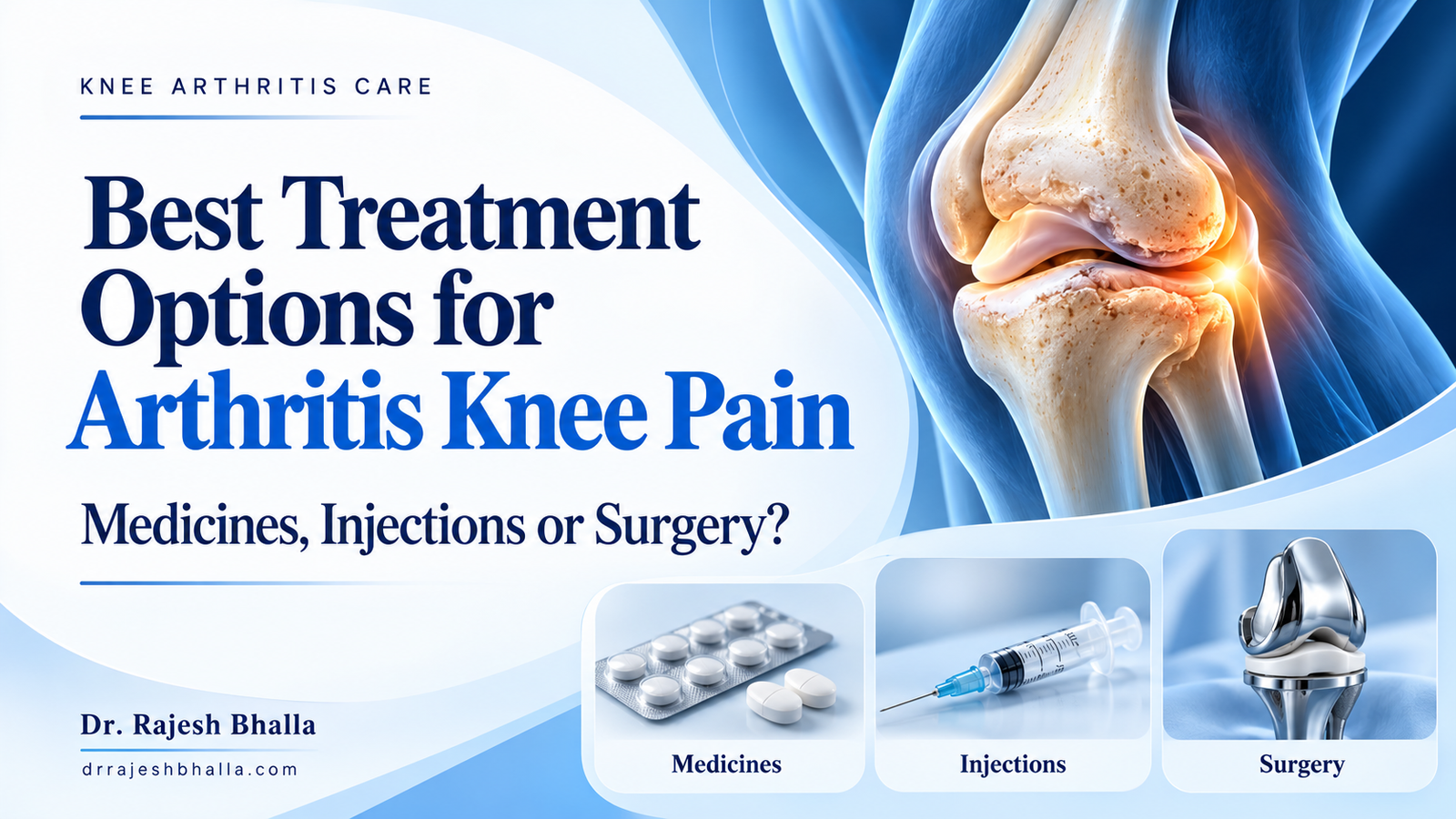
Best Treatment Options for Arthritis Knee Pain: Medicines, Injections or Surgery?
Knee arthritis is a common cause of persistent knee pain, stiffness, swelling, and difficulty with everyday activities such as walking, climbing stairs, sitting, or standing for long periods. Although knee arthritis is often associated with ageing, it can also develop due to previous injuries, cartilage damage, excess weight, joint problems, or other factors.
The good news is that arthritis knee pain treatment does not always mean surgery. Depending on the severity of arthritis, symptoms, age, activity level, joint condition, and overall health, treatment may include medicines, physiotherapy, lifestyle changes, injections, or surgery.
The right treatment should be decided after a proper clinical evaluation rather than choosing an injection or surgery simply because it is considered an advanced option.
What Is Knee Arthritis?
Knee arthritis occurs when the cartilage that normally cushions the bones inside the knee joint gradually becomes damaged or worn. As the protective cartilage reduces, the bones may experience increased friction, resulting in pain, stiffness, inflammation, and restricted movement.
Osteoarthritis is one of the most common forms of knee arthritis. However, different types of arthritis can affect the knee, so an accurate diagnosis is important before starting treatment.
Common symptoms may include:
- Persistent or recurring knee pain
- Stiffness, particularly after rest
- Swelling around the knee
- Difficulty walking or climbing stairs
- Reduced knee movement
- Pain while standing or sitting for long periods
- A feeling of grinding or clicking in the knee
- Difficulty performing daily activities
If knee pain is persistent or progressively worsening, an orthopedic evaluation can help identify the underlying cause and determine the appropriate treatment.
How Is Arthritis Knee Pain Diagnosed?
Treatment begins with understanding the condition of the knee. An orthopedic specialist may evaluate your symptoms, medical history, walking pattern, range of motion, muscle strength, and joint stability.
Depending on the individual case, imaging such as an X-ray or other investigations may be recommended to assess joint-space narrowing, cartilage loss, alignment, or other structural changes.
The severity of arthritis is important because early-stage knee arthritis may often be managed with joint-preserving and non-surgical approaches, while advanced arthritis with severe structural damage may require consideration of knee replacement surgery.
Best Treatment Options for Arthritis Knee Pain
There is no single treatment that is suitable for every patient. Knee arthritis treatment is usually selected according to the severity of symptoms and the condition of the joint.
1. Medicines for Knee Arthritis
Medicines may be recommended to help control pain and inflammation associated with arthritis.
Depending on the patient’s condition, an orthopedic doctor may recommend appropriate pain-relieving or anti-inflammatory medication.
However, medicines should not be taken regularly without medical guidance. Some medicines can have side effects or may not be suitable for people with certain medical conditions.
Medicines can help manage symptoms, but they do not necessarily restore damaged cartilage. Therefore, they are often combined with other measures such as exercise, physiotherapy, weight management, and activity modification.
2. Physiotherapy and Exercise
Physiotherapy is an important part of arthritis knee pain treatment, particularly in mild to moderate arthritis.
A structured exercise program can help improve:
- Quadriceps and hamstring strength
- Knee stability
- Flexibility
- Balance
- Mobility
- Functional ability
Strengthening the muscles around the knee can help support the joint and improve movement.
Exercises should be selected according to the patient’s condition. High-impact activities that increase pain may need to be modified, while low-impact activities can often be incorporated under professional guidance.
3. Weight Management and Lifestyle Changes
Excess body weight can place additional stress on the knee joint. For people who are overweight, appropriate weight management may form an important part of a comprehensive knee arthritis treatment plan.
Lifestyle modifications may include:
- Maintaining a healthy body weight
- Choosing appropriate low-impact exercises
- Avoiding activities that repeatedly aggravate knee pain
- Strengthening the muscles around the knee
- Maintaining regular physical activity within comfortable limits
These measures may help reduce stress on the knee and improve overall mobility.
4. Knee Injections for Arthritis Pain
When medicines, exercise, and other conservative treatments do not provide adequate relief, injections may be considered in selected patients.
Depending on the diagnosis and individual circumstances, options may include different types of injections such as corticosteroid injections, viscosupplementation, or platelet-rich plasma (PRP).
i.Corticosteroid Injections
Corticosteroid injections may provide temporary relief from pain and inflammation in some patients.
They may be considered when inflammation and pain are affecting mobility or daily activities. However, they are not appropriate for everyone, and the frequency and suitability of injections should be determined by an orthopedic specialist.
ii.Viscosupplementation
Viscosupplementation involves injecting a hyaluronic-acid-based preparation into the knee joint. It may be considered in selected patients with osteoarthritis to help manage symptoms.
Its effectiveness can vary from person to person, so it should not be viewed as a guaranteed solution for every patient.
iii.PRP Injections
PRP, or platelet-rich plasma, uses a concentrated preparation derived from the patient’s own blood.
PRP may be considered in certain patients with knee pain or early-stage degenerative changes. However, treatment suitability and expected benefits depend on the individual diagnosis and severity of joint damage.
Dr. Bhalla’s knee arthritis treatment approach includes options such as medications, physiotherapy, PRP injections, and viscosupplementation where clinically appropriate.
5. Joint Preservation Treatment
Not every painful arthritic knee needs to be replaced immediately.
In suitable patients, particularly those with early to moderate arthritis, treatment may focus on preserving the natural knee for as long as possible.
Joint preservation may involve a combination of:
- Medicines
- Physiotherapy
- Muscle strengthening
- Weight management
- Injections
- Activity modification
- Movement correction
The objective is to reduce pain, improve mobility, and maintain knee function while delaying or potentially avoiding surgery in appropriately selected patients.
6. When Is Knee Replacement Surgery Needed?
Knee replacement surgery is generally considered when arthritis has progressed significantly and non-surgical treatments are no longer providing meaningful relief.
Surgery may be considered when a patient has:
- Severe or persistent knee pain
- Significant cartilage or joint damage
- Major difficulty walking
- Difficulty performing everyday activities
- Persistent symptoms despite appropriate non-surgical treatment
- Significant reduction in quality of life
Knee replacement should not be decided based solely on age or an X-ray. The patient’s symptoms, joint condition, functional limitations, overall health, and response to previous treatment all need to be considered.
Dr. Bhalla’s approach emphasizes considering knee preservation where appropriate and using knee replacement when pain, structural damage, and loss of function make joint-preserving treatment insufficient.
Medicines vs Injections vs Surgery: Which Is Better?
The answer depends on the individual patient.
| Treatment | Usually Considered For | Main Goal |
|---|---|---|
| Medicines | Pain and inflammation | Symptom relief |
| Physiotherapy | Mild to moderate symptoms | Strength and mobility |
| Lifestyle changes | Most stages | Reduce joint stress |
| Injections | Selected patients with persistent symptoms | Pain relief and improved function |
| Joint preservation | Early to moderate arthritis | Preserve the natural knee |
| Knee replacement | Advanced arthritis | Replace severely damaged joint surfaces |
There is no universal “best” treatment for arthritis. The appropriate option depends on the patient’s symptoms, diagnosis, severity of joint damage, activity level, and treatment goals.
When Should You See an Orthopedic Specialist?
Do not ignore knee pain simply because it is common with age.
You should consider an orthopedic consultation if:
- Knee pain continues for several weeks
- Pain is becoming progressively worse
- You have difficulty walking or climbing stairs
- Your knee frequently becomes swollen
- You experience significant stiffness
- Pain is interfering with sleep or daily activities
- Conservative treatment is no longer providing sufficient relief
Early assessment may help identify the problem and determine whether the knee can be managed with non-surgical treatment or whether a surgical option should eventually be considered.
Arthritis Knee Pain Treatment in Delhi
For people looking for arthritis knee pain treatment in Delhi, the first step should be a detailed evaluation rather than choosing a treatment solely based on advertisements or online recommendations.
Prof. Dr. Rajesh Bhalla is an orthopedic surgeon in Delhi providing treatment for knee arthritis, knee replacement, joint conditions, sports injuries, and other orthopedic problems. His website highlights personalized treatment planning based on diagnosis, lifestyle, age, and mobility goals, including both surgical and non-surgical approaches.
The clinic is located at JMC Hospital, Joshi Road, Karol Bagh, New Delhi.
Frequently Asked Questions
1. What is the best treatment for arthritis knee pain?
The best arthritis knee pain treatment depends on the severity of arthritis and the patient’s symptoms. Treatment may include medicines, physiotherapy, lifestyle changes, injections, joint preservation, or surgery.
2. Can knee arthritis be treated without surgery?
Yes. Many patients, particularly those with early or moderate arthritis, may benefit from non-surgical treatment such as exercise, physiotherapy, medicines, weight management, and selected injections.
3. Are knee injections effective for arthritis?
Knee injections may provide symptom relief for selected patients. Different injections have different purposes, and their suitability depends on the diagnosis and severity of arthritis.
4. Are PRP injections useful for knee arthritis?
PRP injections may be considered for selected patients with knee pain and degenerative changes. However, the expected benefit varies between individuals and should be discussed with an orthopedic specialist.
5. When is knee replacement surgery needed for arthritis?
Knee replacement surgery may be considered when arthritis causes severe pain, significant joint damage, difficulty performing daily activities, and inadequate relief from appropriate non-surgical treatments.
6. Can physiotherapy help knee arthritis?
Yes. Physiotherapy can help improve muscle strength, flexibility, mobility, and knee function and may be an important part of knee arthritis treatment.
7. Does every patient with knee arthritis need a knee replacement?
No. Knee replacement is not automatically required for every patient with arthritis. Treatment should be based on symptoms, joint damage, functional limitations, and response to other treatments.
8. Can weight loss help with arthritis knee pain?
For people who are overweight, appropriate weight management can reduce stress on the knee and may support better mobility and symptom management.
9. How can I know whether I need injections or surgery?
A clinical examination and appropriate imaging can help determine the severity of arthritis. An orthopedic specialist can then discuss whether medicines, injections, joint-preserving treatment, or surgery is appropriate.
10. Where can I get knee arthritis treatment in Delhi?
Patients looking for knee arthritis treatment in Delhi can consult an orthopedic specialist for diagnosis and an individualized treatment plan. Prof. Dr. Rajesh Bhalla provides orthopedic care in Karol Bagh, New Delhi.