Dr. Rajesh Bhalla
Senior Orthopedic Surgeon
Delhi, India | 20+ Years of Experience
Introduction
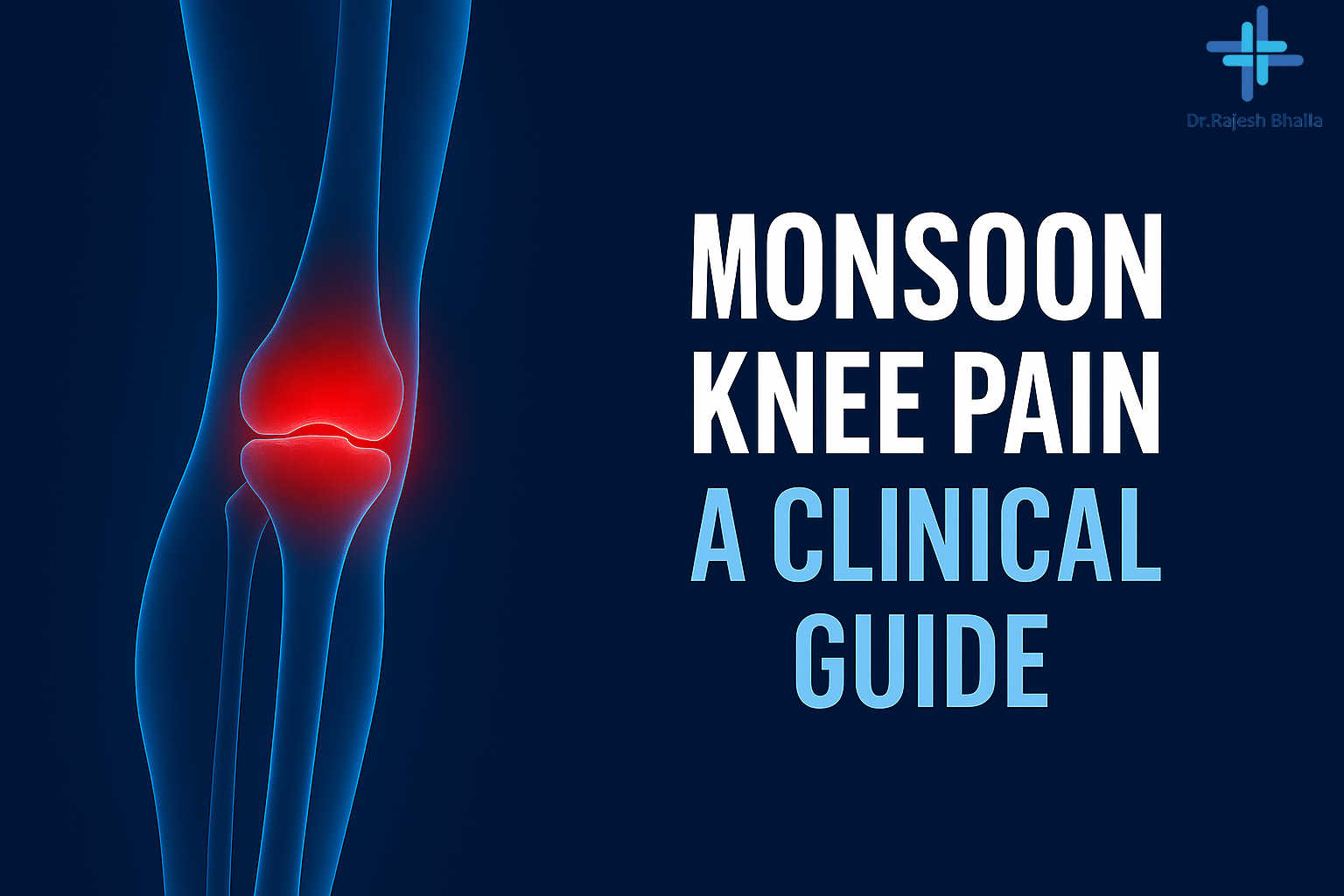
Monsoon knee pain is not anecdotal. It is a medically observable increase in joint complaints during the monsoon season, particularly among patients with degenerative joint disease, muscle deconditioning, or vitamin D deficiency. As a senior orthopedic surgeon with over 20 years of clinical experience, I consistently observe a rise in knee-related complaints during the June–September monsoon window in Delhi.
Why Does Knee Pain Increase During Monsoon?
– Barometric pressure drops: Causes mild joint capsule expansion and tension on synovium and nerve endings.
– Synovial fluid thickens: Cold and humidity reduce lubrication, increasing joint friction.
– Reduced sunlight: Leads to lower Vitamin D3 synthesis, weakening bones and delaying recovery.
– Reduced muscle use: Leads to quadriceps and hamstring weakening, destabilizing the joint.
– Fall risk: Wet environments raise the risk of ligament sprains or meniscal injuries.
Case Scenarios from Practice
Case 1: A 52-year-old office worker with early-stage OA presents with medial knee stiffness and pain during the monsoon. The exam shows crepitus and joint line tenderness.
Management: NSAIDs, Vitamin D3 weekly doses, viscosupplementation, quadriceps-focused rehab.
Case 2: A 68-year-old with bilateral OA has increased instability and fear of falling.
Management: Neoprene braces, balance therapy, home modifications, and planned partial knee replacement.
Diagnostic Workflow
– Clinical tests: Patellar grind, McMurray’s, varus-valgus stress.
– Imaging: Weight-bearing X-rays, MRI for persistent or severe cases.
– Blood tests: Vitamin D3, ESR, CRP where indicated.
Preventive Management
– 15–20 min/day closed-chain quad exercises (e.g., wall sits).
– Vitamin D3 supplementation as per levels.
– Indoor cycling or elliptical training 3x/week.
– Avoid squatting and overuse during flare-ups.
– Orthotic footwear and thermal bracing.
– Home safety modifications (grab rails, elevated chairs).
Treatment Strategy
Stage 1 – Conservative: NSAIDs, physiotherapy, oral supplements.
Stage 2 – Injections: Hyaluronic acid (1–3 sessions), PRP for soft-tissue regeneration.
Stage 3 – Surgical: Arthroscopy for debridement; Robotic-assisted unicompartmental or total knee replacement depending on OA grade.
International Patient Pathway
We consult global patients from the UAE, Africa, the UK, and Southeast Asia, especially during the monsoon.
– Teleconsultation with imaging review.
– Pre-op scheduling and travel coordination.
– Local rehab support post-discharge.
Summary
– Monsoon knee pain is often an early indicator of joint degeneration.
– Timely orthopedic evaluation and graded treatment can delay or avoid surgery.
– Patients benefit most from a personalized, structured, evidence-driven plan.
Call to Action
To discuss your symptoms or refer a patient, schedule a consultation with Dr. Rajesh Bhalla.
Teleconsultation is available globally. Specialized in joint preservation, robotic knee solutions, and evidence-based orthopedic care.